Philadelphia Home Heating: Ductless vs. Traditional HVAC Systems for City Row Homes and Suburban Houses
How Philadelphians Keep Their Home’s Warm in Winter
Look, if you’re reading this in January while your radiator’s clanking like someone’s banging pipes or you’re cranking up space heaters because your system can’t keep up, you’re not alone. Philadelphia homes are as different as the neighborhoods they’re in, and what works for a single-family in Delco isn’t going to cut it for a Fishtown row home or a Queen Village trinity.
Here’s the reality: most of Philly’s housing stock was built before anyone thought about central air or modern HVAC. We’ve got row homes where walls touch from Girard to Passyunk, historic properties in Society Hill that predate the Constitution, and converted multi-family buildings in University City where “adding ductwork” isn’t just expensive, it’s impossible. Then you’ve got the suburbs, Bucks County, Montgomery County, Delaware County, where single-family homes have attics, crawl spaces, and room to actually run ducts.

The heating system that’s right for your home depends on what you’re working with. Traditional forced-air systems are fantastic when you’ve got the space and structure for them. Ductless mini-splits are the solution when you don’t, and in Philadelphia proper, most of us don’t. This isn’t about what’s “better” in some abstract sense. It’s about what actually works in your specific house, on your specific block, with your specific setup.
Why Philadelphia’s Housing Stock Makes Heating Complicated
Philadelphia is one of the oldest major cities in America, and our homes show it. We’re talking about construction that spans three centuries. Walk down any block in South Philly, Northern Liberties, or Manayunk, and you’ll see row homes built in the 1920s sitting next to twins from the 1880s next to new construction trying to fit the same footprint.
The defining characteristic of Philadelphia city homes is simple: they’re attached. Your walls are your neighbor’s walls. There’s no crawl space underneath because you’re built on a slab or you’ve got a basement that’s seven feet tall if you’re lucky. There’s no attic because you’ve got a flat roof or a tiny access point that barely fits a person. When HVAC contractors talk about “running ductwork,” they’re talking about tearing into walls, dropping ceilings, and fundamentally changing your home’s layout.
Row homes and twins weren’t designed for central air. They were built for coal, then converted to oil, then switched to gas. Radiators and baseboard heat made sense because they didn’t require the spatial infrastructure that forced-air systems demand. Most of these homes have beautiful original features: crown molding, hardwood floors, exposed brick, plaster walls. Ripping into them to retrofit ductwork isn’t just expensive, it destroys what makes these properties valuable.
Then you’ve got the historic district considerations. If you’re in Old City, Society Hill, or anywhere that falls under historical preservation guidelines, your renovation options are limited. You can’t just start cutting holes and running ducts through a property that’s on the register. Even outside official historic areas, many Philly homeowners are protective of their home’s character. Nobody wants to sacrifice original details for modern convenience if there’s another way.
Contrast that with the suburbs. Out in Haverford, Narberth, Conshohocken, Lansdale, and the surrounding townships, you’ve got single-family homes with actual attics, proper basements, and space between properties. These homes were often built with forced-air systems in mind, or they have the infrastructure to add them without major renovation. When an HVAC contractor shows up to a suburban home, they’ve usually got clear paths for ductwork and equipment placement.
How Winter Hits Different in the City Versus the Suburbs
Anyone who’s lived in both Center City and the suburbs knows: winter feels different depending on where you are. It’s not just perception, it’s physics and urban design working against you or with you.
In the city, particularly in row homes and multi-family buildings, heat loss happens differently. When your walls are shared with neighbors, you’re actually getting passive heat transfer. If your neighbor’s cranking their heat, your shared wall stays warmer. The density of Philadelphia’s urban core creates microclimates. Buildings block wind. Streets trap heat. You’re insulated by the sheer proximity of other heated structures.
But that same density creates problems. Philadelphia row homes are notoriously drafty. Old windows, minimal insulation by modern standards, and gaps around doors that have settled over a century create constant air infiltration. You’ll feel cold even when your thermostat says 68 degrees because you’ve got drafts coming from everywhere. The narrow footprint of row homes means you’re often heating tall, skinny spaces where warm air rises and stays upstairs while the first floor stays cold.

Winter in the city also means less direct sunlight. Tall buildings block sun for big portions of the day. North-facing row homes might not see direct sunlight for weeks at a time in December and January. Without that passive solar gain, your heating system works overtime.
Out in the suburbs, you’re dealing with exposure. Single-family homes have four exterior walls instead of two. You’re losing heat in every direction. When the wind whips across an open lot in Springfield or Horsham, you feel it. Suburban homes typically have better insulation because they were built more recently or have been updated, but they’re heating larger square footage with more exposed surfaces.
The trade-off is that suburban homes usually have better air sealing and more consistent heating distribution. When you’ve got a properly installed forced-air system with ductwork running throughout the house, every room gets consistent heat. You don’t have the “upstairs is roasting, downstairs is freezing” problem that plagues multi-story city row homes with radiators or baseboard heat.
Temperature swings hit differently too. In the dense city core, temperatures moderate. It might be 28 degrees in Chestnut Hill while it’s 33 degrees in Rittenhouse because of the urban heat island effect. Those few degrees matter when you’re right at the freezing point. Suburban homes see wider temperature swings and need heating systems that can respond quickly when overnight temps drop.
Traditional Forced-Air HVAC Systems: When They Work and When They Don’t
Traditional forced-air systems are the standard for good reason. They’re efficient, they’re effective, and when you’ve got the right home for them, they’re hard to beat. These systems use a central furnace or heat pump to generate warm air, then distribute it throughout your home via ductwork. The same system cools your house in summer, making it a year-round solution.
For suburban Philadelphia homes, single-family properties with proper spatial infrastructure, forced-air makes complete sense. You’ve got an attic or basement where equipment can live. You’ve got interior walls and ceiling cavities where ducts can run. Installation is straightforward, and the system heats your entire home from one central unit. Modern forced-air systems are quiet, efficient, and reliable.
The fuel source matters. Most suburban homes run on natural gas, which is cost-effective and widely available through PECO Energy or local municipal gas services. Gas furnaces deliver powerful, consistent heat even when outdoor temperatures plummet. Electric heat pumps are gaining popularity, especially newer cold-climate models that work efficiently even in single-digit temperatures, but gas still dominates in this region because of cost per BTU.
Traditional systems also integrate well with whole-home solutions. You can add humidifiers to combat dry winter air. Air purifiers and filtration systems tie directly into your ductwork. Zoning systems let you control different areas independently. If you’re building new construction or you’ve got a home that’s already set up for it, forced-air is often the most practical choice.
But here’s where traditional systems fail in Philadelphia proper: they require space and infrastructure that city homes simply don’t have. You cannot retrofit ductwork into a typical Philadelphia row home without massive, invasive, expensive renovation. Contractors will tell you it’s possible, and technically it is, but you’re looking at dropped ceilings, boxed-in ducts running along walls, lost closet space, and costs that often exceed what makes financial sense.
Even when you can physically install ductwork, the layout rarely works well. Row homes are narrow and vertical. Trying to get even air distribution across three or four floors through ductwork that has to navigate tight spaces and make sharp turns results in inconsistent heating. Your third floor might be comfortable while your first floor stays cold because the system can’t overcome the inherent challenges of the building’s geometry.
For older Philadelphia homes, there’s also the issue of existing systems. Many row homes still run on radiators or baseboard heat powered by boilers. These systems work. They’re paid for. Ripping them out to install forced-air means you’re junking functional equipment and spending tens of thousands of dollars for a system that might not even perform better given your home’s limitations.
Ductless Mini-Split Systems: The Solution for Philadelphia Row Homes and Historic Properties
Ductless mini-split systems were essentially invented for situations like Philadelphia’s urban housing stock. They deliver heating and cooling without requiring ductwork, making them perfect for row homes, twins, historic properties, and any building where traditional HVAC isn’t feasible.
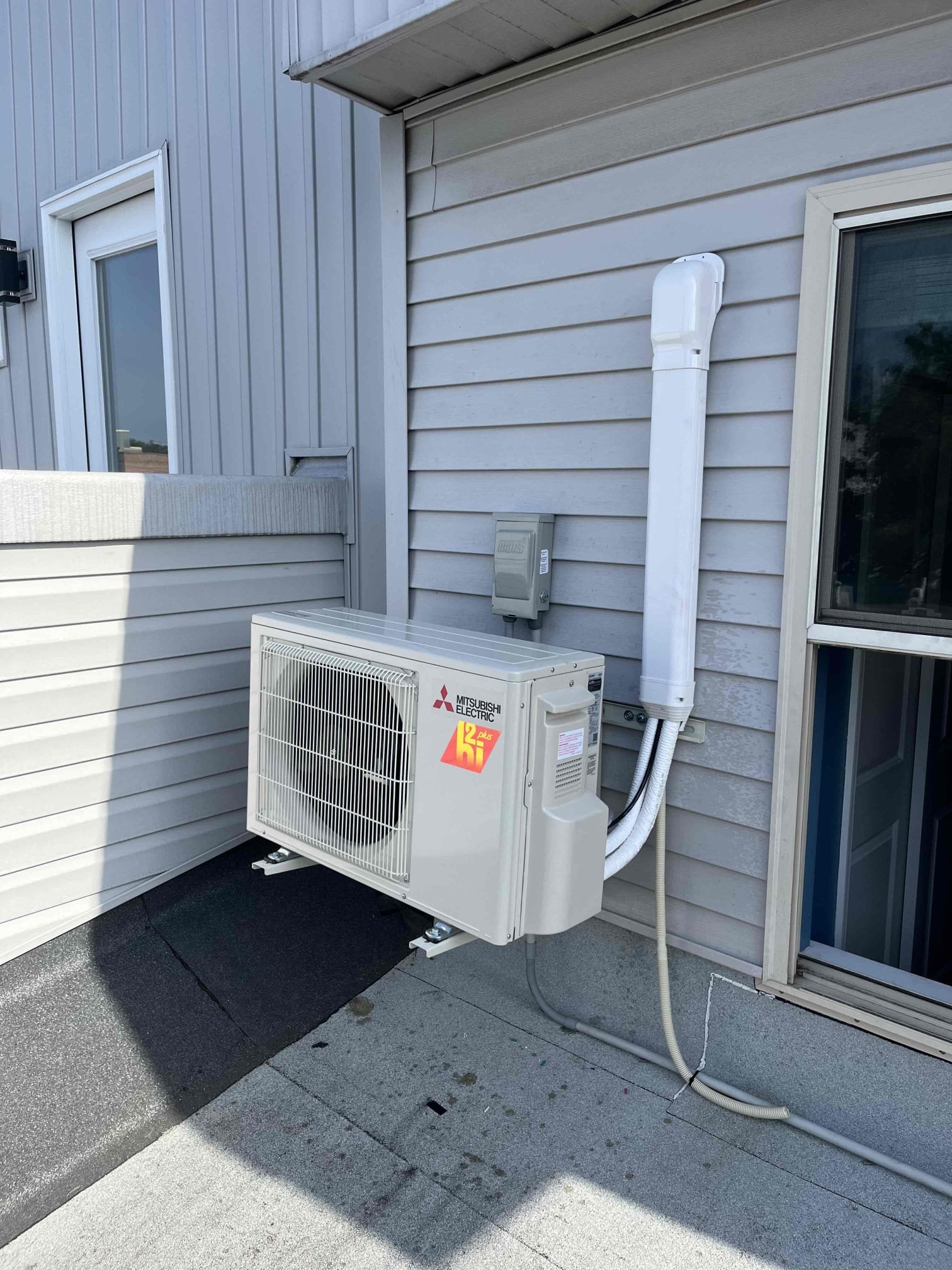
Here’s how they work: you’ve got an outdoor compressor unit and one or more indoor air handlers mounted on walls or ceilings. A small line set (refrigerant lines and electrical) connects them through a three-inch hole in your exterior wall. That’s it. No ducts, no major renovation, no destroying your home’s interior to make it work. Installation typically takes one or two days, and you’re heating and cooling spaces that never had proper climate control before.

For Philadelphia row homes, this is transformative. You can put an air handler in your living room, one in your bedroom, maybe one on the third floor if you’ve got it. Each unit operates independently, so you’re not heating rooms you’re not using. You control each zone separately, which solves the “upstairs hot, downstairs cold” problem that radiators create. Modern mini-splits are incredibly efficient, often more so than traditional systems, because you’re not losing energy through ductwork and you’re only conditioning the spaces you’re actually occupying.
The historic property advantage is huge. If you’re in a home with original details you want to preserve, ductless doesn’t require you to sacrifice anything. No ripping out plaster walls, no dropped ceilings, no visible ductwork destroying your sightlines. The indoor units are sleek and unobtrusive. Some homeowners worry about aesthetics, but modern units are far better looking than window air conditioners, and they’re professionally installed, not jutting out of your window all summer.
Ductless systems handle both heating and cooling, which is critical in Philadelphia. We get humid summers where you need serious cooling capacity, and we get January stretches where it doesn’t get above 20 degrees for days. Quality mini-splits, particularly cold-climate models from manufacturers like Mitsubishi, Daikin, and Fujitsu, operate efficiently down to negative temperatures. They use heat pump technology, which is more efficient than electric resistance heat, and they outperform window units and portable systems by a massive margin.
The energy savings are real. Because you’re not heating your entire house when you’re only using two rooms, and because modern inverter-driven compressors adjust their output precisely to match demand, many homeowners see significant reductions in energy costs compared to older radiator systems or space heaters. You’re also getting cooling included, which means you can ditch those window units that leak air and drive up summer electric bills.
Installation is less invasive, but it’s not invisible. You’ll have wall-mounted units in your living spaces. Some people love the modern look, others tolerate it because the comfort and efficiency gains outweigh aesthetic concerns. The outdoor compressor needs a place to live, usually mounted on a rear wall or in a small side yard if you’ve got one. In dense row home areas, that often means the unit is visible from the alley, but that’s standard.
One consideration: ductless systems work best when they’re sized and installed correctly. Undersizing means your system can’t keep up during extreme temperatures. Oversizing means inefficient cycling and temperature swings. This is where working with contractors who specialize in Philadelphia’s unique housing stock matters. Someone who installs systems in suburban developments all day might not understand the challenges of a 120-year-old South Philly row home with minimal insulation and drafty windows.
Comparing Costs: Installation, Operation, and Long-Term Value
Money talks, especially when you’re looking at a major home investment. Let’s break down what these systems actually cost in real Philadelphia terms.
Traditional forced-air system installation in a suburban home runs anywhere from $8,000 to $15,000 for a straightforward replacement of an existing system. If you’re adding air conditioning to a home that only had heat, or if ductwork needs modification, you’re looking at the higher end or beyond. New construction or gut renovations where ductwork is being installed from scratch can run $12,000 to $20,000 depending on home size and system quality.
For a Philadelphia row home where no ductwork exists, retrofitting a traditional system isn’t $15,000. It’s $25,000, $30,000, potentially more once you account for the structural work, dropped ceilings, interior renovation, and the complexity of making it function in a space that fights you every step. Most homeowners quickly realize it doesn’t make financial sense.
Ductless mini-split installation is more accessible for city homes. A single-zone system (one outdoor unit, one indoor head) runs $3,500 to $6,000 installed. Multi-zone systems, which are more common for row homes where you’re conditioning multiple floors or rooms, range from $7,000 to $12,000 depending on the number of zones, the system’s capacity, and installation complexity. That’s comparable to or less than traditional systems, and you’re not destroying your home’s interior to make it happen.
Operating costs depend heavily on fuel source and system efficiency. Natural gas heat is generally the cheapest option for heating in this region. If you’re running a modern high-efficiency gas furnace, your winter heating bills in a well-insulated suburban home might run $150 to $300 monthly during cold months. Older, less efficient systems or poorly insulated homes can see bills double that.
Ductless mini-splits run on electricity, which makes some homeowners nervous about costs. However, heat pump efficiency means you’re getting three to four units of heat for every unit of electricity consumed. Compare that to electric resistance heat (baseboard heaters, space heaters), which is one-to-one. A properly sized ductless system in a Philadelphia row home typically costs $120 to $250 monthly in winter, and because you’re zone-controlling and not heating unused spaces, many homeowners find their total energy costs drop compared to old radiator systems or running multiple space heaters.
Summer cooling costs favor ductless significantly. Window air conditioners are energy hogs, and running three or four of them in a row home can spike electric bills to $200 to $300 monthly in July and August. A multi-zone ductless system providing whole-home cooling typically runs $100 to $180 monthly, and you’re getting better comfort with consistent temperatures and humidity control.
Maintenance costs are comparable. Traditional systems need annual service, filter changes, and occasional duct cleaning. Ductless systems need annual maintenance and filter cleaning, which homeowners can often do themselves. Both systems have lifespans of 15 to 20 years with proper care, though ductless systems often last longer because they’re not subject to the wear that ductwork and air handlers in unconditioned spaces experience.
The wildcard is PGW bills for gas heat versus PECO electric bills for ductless. Gas prices fluctuate, but natural gas has historically been stable and relatively cheap in this region. Electricity costs more per BTU, but heat pump efficiency closes that gap. For homeowners concerned about fossil fuel dependence or wanting to reduce carbon footprint, ductless electric systems offer that option without sacrificing comfort.
Long-term value considerations matter too. Adding or upgrading HVAC increases home value, but the return depends on what buyers expect. In the suburbs, buyers expect central air and forced-air heat. Not having it is a strike against you. In the city, expectations are different. A row home with a modern ductless system is more attractive than one with old radiators and window units. You’re not going to get your full investment back immediately, but you’re making the property more competitive and livable.
Gas Versus Electric: Fuel Sources and What Makes Sense in Philadelphia
The fuel conversation in Philadelphia comes down to infrastructure, cost, and increasingly, personal values around energy use. Both gas and electric heating have strong cases depending on your situation.
Natural gas heating dominates suburban Philadelphia because it’s effective and economical. PECO Energy provides natural gas service throughout the region, and most single-family homes built in the last 50 years have gas lines. Gas furnaces deliver powerful heat quickly. When it’s 15 degrees outside and you need your house warm, gas furnaces respond immediately. They’re not dependent on outdoor temperature for efficiency, they just burn fuel and generate heat.
For city row homes, the gas situation is different. Many rely on Philadelphia Gas Works (PGW) for service. PGW is a municipal utility, which means rates and service are different than private providers. Some very old row homes are still set up for oil heat or converted systems. Gas boilers feeding radiators are common, and they work fine, but they’re not efficient by modern standards and they don’t provide cooling.
Electric heating via heat pumps (which is what ductless mini-splits use) has gotten significantly better in recent years. Old electric heat meant resistance heating, which was expensive and barely kept up in cold weather. Modern cold-climate heat pumps work efficiently even when temperatures drop below zero. They extract heat from outdoor air even in freezing conditions, and they do it at three to four times the efficiency of resistance heating.
The cost comparison is straightforward. Natural gas in this region costs roughly $1 to $1.50 per therm depending on the season and your provider. Electricity costs about $0.13 to $0.16 per kWh through PECO. When you run the numbers accounting for heat pump efficiency versus furnace efficiency, electric heat pumps and gas furnaces end up close in operating costs, with gas having a slight edge in the coldest months.
Where electric heat pumps win is versatility. They heat and cool with the same equipment. You’re not running a furnace in winter and air conditioning in summer, you’re running one system year-round. That’s a major advantage for row homes where space is limited and you don’t want multiple systems competing for room.
There’s also the future consideration. Energy codes are moving toward electrification. Some municipalities are beginning to restrict new gas hookups in new construction. While this isn’t affecting existing Philadelphia homes yet, the trend suggests electric systems might have better long-term policy support and potentially better rebate and incentive programs.
For homeowners concerned about backup heating, having multiple fuel options provides security. If you’ve got gas radiators as your primary heat and you add ductless mini-splits, you’ve got redundancy. If one system fails, you’re not without heat. This is practical in older homes where equipment age makes failure more likely.
The environmental angle matters to some homeowners. Natural gas is a fossil fuel. Burning it releases carbon directly into the atmosphere. Electric heat pumps are only as clean as the grid they’re powered by, but as Pennsylvania’s grid incorporates more renewable energy, heat pumps get cleaner over time. For homeowners prioritizing carbon footprint reduction, electric heat pumps are the clearer path.
Rebates and incentives currently favor heat pump installations. Federal tax credits, state programs, and utility incentives make ductless mini-split systems more affordable upfront. Gas furnaces don’t typically qualify for the same level of incentives unless they’re ultra-high-efficiency models.
System Age and Replacement: When to Upgrade Your Philadelphia Home’s Heating
Nothing lasts forever, and that includes heating systems. Philadelphia’s housing stock means we’re dealing with equipment that ranges from brand new to older than most people reading this.
If you’re in a row home with radiators that were installed when Eisenhower was president, they might still work, but they’re not efficient. Old cast-iron radiators are nearly indestructible, but the boilers feeding them wear out. Boiler replacement costs $4,000 to $8,000 depending on size and complexity, and you’re still dealing with an outdated heating method that doesn’t cool, doesn’t provide zone control, and wastes energy.
Forced-air furnaces typically last 15 to 20 years. If your suburban home’s furnace is approaching that age, especially if it’s original equipment from when the house was built in the 1990s or early 2000s, you’re on borrowed time. Older furnaces are less efficient, often 80% AFUE (Annual Fuel Utilization Efficiency) or lower, compared to modern systems that achieve 95% to 98% AFUE. The efficiency gain alone can justify replacement even if your old system still technically works.
Air conditioning units last 12 to 15 years in this climate. Philadelphia’s humid summers work cooling equipment hard. If your central air is making noise, struggling to keep up, or requiring frequent repairs, replacement makes more sense than throwing money at an aging system.
For city homeowners still relying on window air conditioners, the lifespan is shorter, usually 8 to 10 years, and efficiency degrades quickly. Window units from even five years ago are significantly less efficient than current models, and they’re all drastically less efficient than ductless systems.
The decision to upgrade isn’t just about equipment age, it’s about cost and comfort. If you’re spending $3,000 annually heating a row home with an old boiler and radiators, and another $1,000 running window units in summer, that’s $4,000 yearly in operating costs. A ductless system might cost $9,000 installed and cut your annual energy costs to $2,500. You’re breaking even in four to five years and gaining enormous comfort improvements.
Replacement timing matters strategically. Don’t wait until your system dies in January or July when you’re desperate and paying emergency service rates. Plan upgrades during shoulder seasons (spring and fall) when contractors aren’t slammed and you can get better pricing and more thoughtful installation.
For suburban homes with aging forced-air systems, replacement with modern high-efficiency equipment is usually the straightforward choice. You’ve got the infrastructure, you’re just swapping old for new. For city homes, aging heating systems present an opportunity to switch to ductless and gain cooling capability you might not have had before.
One warning: don’t let failing equipment force poor decisions. Some contractors will push whatever system they’re comfortable installing, regardless of whether it fits your home. A suburban HVAC company might try to sell you on ducted systems for a row home because that’s what they know, even when ductless makes more sense. Work with contractors who understand Philadelphia’s specific housing types and can recommend appropriate solutions.
Making the Right Choice for Your Specific Philadelphia Home
The system that’s right for your home isn’t about what’s theoretically best, it’s about what actually works in your specific building on your specific block.
If you’re in Center City, South Philly, Northern Liberties, Fishtown, or anywhere in the urban core where row homes and twins dominate, ductless is almost certainly your answer. You don’t have space for ductwork, retrofit costs don’t make sense, and ductless delivers both heating and cooling in a package that fits your home’s physical reality. Modern systems handle Philadelphia’s temperature extremes comfortably, and you’re gaining zone control and efficiency that old radiators and window units can’t match.
For historic homes in Society Hill, Old City, Queen Village, or any property where preservation matters, ductless is the path that doesn’t compromise your home’s character. You’re not ripping out plaster, you’re not boxing in ductwork, you’re not sacrificing original features for climate control. The small wall penetrations for line sets are reversible if needed, and the interior units are far less intrusive than alternatives.
If you’re in the suburbs, Bucks County, Montgomery County, Delaware County, in a single-family home with existing ductwork or the infrastructure to support it, traditional forced-air systems are tough to beat. They’re efficient, they’re comprehensive, and they’re what the housing stock was designed for. Modern high-efficiency furnaces paired with quality air conditioning provide reliable year-round comfort without the complexity of multiple zone systems.
For suburban homes without existing ductwork, the calculation changes. If you’re in an older home that’s been heated by radiators or baseboard and you want to add cooling, ductless becomes attractive even in single-family settings. The cost of retrofitting ducts might exceed what ductless would cost, and you’d get comparable performance with less invasion into your home’s structure.
Some homeowners benefit from hybrid approaches. Keep your existing gas radiators as primary heat and add a ductless system primarily for cooling with backup heating capability. This works in homes where the heating system is functional but you’re desperate for better cooling than window units provide.
Talk to contractors who actually know Philadelphia. Someone who installs a hundred systems a year in Chester County subdivisions doesn’t necessarily understand the challenges of a Passyunk row home or a Manayunk twin. Ask them specifically about their experience with your type of property. Look for contractors who can show you similar installations in similar homes.
Get multiple quotes, but understand you’re not comparing apples to apples if one contractor is quoting ductless and another is quoting forced-air retrofit. Compare similar systems from different contractors, and pay attention to equipment quality. Cheap mini-splits from unknown brands will disappoint. Stick with established manufacturers known for reliability and cold-climate performance.
Consider your timeline. If your current system is dying and you need heat now, emergency solutions might be necessary. But if you’ve got time to plan, use it. Research systems, get recommendations, schedule installations when contractors can give your project proper attention.
Think about your long-term plans. If you’re planning to sell in two years, your calculation is different than if you’re settling in for twenty. That said, comfort matters. Don’t suffer through another summer with inadequate cooling or another winter with uneven heat just because you might move eventually.
Philadelphia’s housing diversity means there’s no universal answer, but there are clear patterns. Dense urban housing with physical constraints points toward ductless. Suburban single-family homes with spatial infrastructure points toward traditional forced-air. Historic properties requiring preservation point toward ductless. Understanding which category your home falls into makes the decision straightforward.
The bottom line is this: heating and cooling your Philadelphia area home properly means matching the right technology to your specific building. Don’t force systems into homes that fight them. Choose the approach that works with your home’s reality, not against it.