
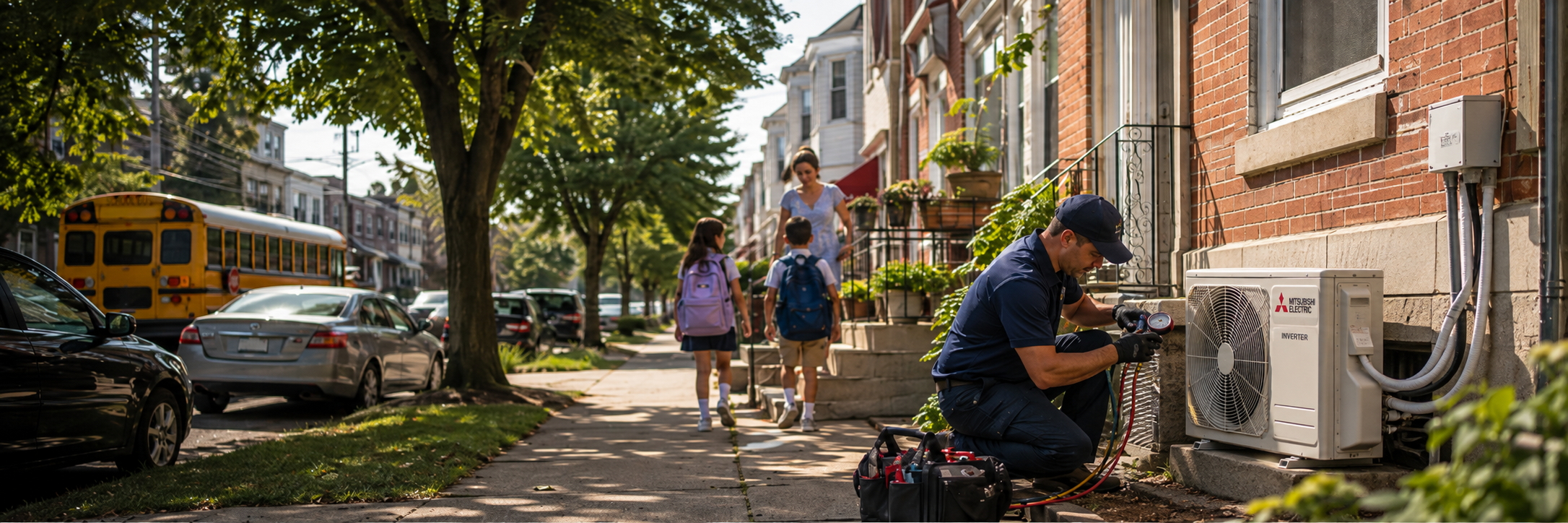
Your AC Isn’t Done Yet: Why August Is Philly’s Last Real Shot at HVAC Maintenance Before the School Bell Rings
The house is about to get busy again. Your HVAC system needs to be ready before your kids are.
Right now, your AC is still working. It kicked on this morning, it’ll kick on tonight, and if it’s kept up that pace since May without a single tune-up, you’ve probably stopped thinking about it altogether. That’s the problem. August in Philadelphia isn’t the finish line for your cooling system, it’s the last stretch of a marathon that started back in June, and it’s about to hand off straight into a September full of packed lunches, early alarms, and a house that needs to hold steady no matter what the thermostat’s asked to do. Between now and the yellow buses rolling again in Philly, Bensalem, Levittown, and Southampton, this is the window. Not October. Not “when it breaks.” Now, while your system is still running instead of already down.
This isn’t a scare tactic. It’s just how HVAC actually works in a rowhome city that swings from soupy August humidity to a hard freeze in about twelve weeks flat. Skip the tune-up now, and the system that’s been quietly struggling all summer doesn’t get better on its own. It just waits for the worst possible moment to let you know.
The Two Deadlines Hitting Every Philly Household Right Now
Here’s what’s actually converging on your house this month, whether you’ve clocked it or not.
Deadline one: the heat isn’t done with you. This summer, forecasters have been tracking somewhere in the neighborhood of 32 to 38 days of 90-degree-plus heat across the Philadelphia region, right in line with, or ahead of, last year’s stretch. August alone is running with highs regularly pushing into the upper 80s and low 90s. Add in the derecho risk regional forecasters flagged for July and August, the kind of fast-moving, high-wind storm system that can snap power and spike your system with a hard restart, and you’ve got a month where your HVAC system is still working overtime, not coasting to the finish.
Deadline two: the school calendar doesn’t care how tired your AC is. Philadelphia School District students are back in classrooms on August 24. Out in Bensalem, it’s August 31. Neshaminy families are looking at the same week. Across Bucks and the Northeast, most other districts land right around Labor Day. That means in the next few weeks, your house goes from a slow, sprawled-out summer schedule to full send: everybody up early, everybody home late, the thermostat getting bumped up and down by six different hands, and zero patience in the house for a system that decides to quit on a Tuesday night in the middle of homework and bedtime.
Put those two deadlines together and August stops looking like a lazy, nothing month for your HVAC system. It’s the last calm window before both the weather and the household schedule stop giving you any slack.
Why “It’s Still Cooling Fine” Is the Most Expensive Sentence in HVAC
Every HVAC company that’s been doing this a while has heard some version of “it’s still cooling fine” right before a system goes down completely. It’s not that homeowners are wrong about what they’re feeling. It’s that a struggling system and a healthy system can feel identical from the couch, right up until they don’t.
The Repair Bill You Don’t See Coming
A system that’s been running dirty coils, a clogged filter, and low refrigerant all summer isn’t failing quietly. It’s failing loudly, just in a language most people don’t speak. Short cycling. A slightly longer runtime. A faint smell when it kicks on. None of that reads as an emergency in July. By late August or early September, when the compressor finally gives out under the strain, it does read as an emergency, and it’s the single most common reason homeowners end up searching for same-week air conditioning repair in Philadelphia instead of a routine tune-up that would’ve caught it in June, for a fraction of the cost.
The Electric Bill You’re Already Paying
Here’s the part that hits different once you actually think about it: a neglected system doesn’t just risk breaking down, it’s costing you money every single day it’s running dirty. A blocked filter or a coil caked in a summer’s worth of debris makes your system work harder to hit the same temperature, which means higher electric bills for the exact same comfort you’d get from a clean, tuned system for less. You’re not saving money by skipping maintenance. You’re prepaying for a repair bill in monthly installments on your electric statement.
The Back-to-School Connection Nobody Talks About
Most HVAC content connects maintenance to summer heat and stops there. But if you live in Philly, Bensalem, Levittown, or Southampton, back-to-school isn’t just a calendar event, it changes how your house actually runs.
For three months, your house has been on a loose, forgiving schedule. Kids are up whenever, home all day, doors open and closed at random, AC running on a pretty predictable, steady load. The second school starts, that schedule tightens hard: everyone’s up before sunrise when the house is coolest and easiest to condition, then the house sits mostly empty and heat-soaked all afternoon, then everybody piles back in right as the day’s heat peaks and expects the house to catch up fast. That’s a completely different demand pattern than your system has handled all summer, and it’s exactly the kind of shift that exposes a system that’s been running on fumes.
Add in the stuff that comes home with the backpacks, dust, pollen, whatever’s been sitting in a school building all summer, and indoor air quality becomes part of the back-to-school conversation too, especially in older Philadelphia rowhomes and twins where filtration was never built for the load these homes actually carry.
What August Maintenance Actually Catches Before It Becomes a September Emergency
A real tune-up isn’t a five-minute filter swap. It’s a full diagnostic pass built to catch small problems while they’re still small, and cheap.
The R&R Mechanical August Tune-Up Checklist
- Refrigerant levels checked and corrected: low refrigerant is one of the most common reasons a system runs constantly without ever quite catching up
- Coils cleaned, inside and out: a dirty coil is one of the single biggest hidden drains on efficiency
- Filter inspected and replaced: especially critical heading into a season where pollen, dust, and closed-up houses collide
- Electrical connections and capacitors tested: the parts most likely to fail hard, without warning, during a heat spike or a storm-related power surge
- Condensate drain line cleared: a clogged line is a leading cause of water damage and shutdowns in Philly rowhomes with tight mechanical spaces
- Thermostat calibration checked: especially important in households about to run on a tighter, more demanding schedule
- Airflow and ductwork inspected: a make-or-break step in older homes where ductwork was never designed for the system currently attached to it
- Full system run-cycle test: confirming the system starts, runs, and shuts down the way it’s supposed to, not just that it turns on
Every item on that list is something that’s either invisible from the living room or easy to write off as normal, until it isn’t.
Row Home, Twin, or Split-Level: The Fix Isn’t the Same for Everybody
Philadelphia HVAC has never been one-size-fits-all, and pretending otherwise is how homeowners end up with advice that doesn’t apply to their actual house.
A narrow South Philly or Kensington rowhome with original ductwork carries a completely different set of maintenance priorities than a Bensalem or Levittown split-level built decades later with a totally different duct layout, and both of those are different again from a Southampton or Bucks County property running a ductless system in an addition or converted space. Homeowners searching for air conditioning repair in Northeast Philadelphia in particular tend to be dealing with a very specific mix of older rowhome ductwork and additions that were never part of the original mechanical plan, which is exactly the kind of mismatch a generic tune-up misses and a locally-experienced one doesn’t. Tight mechanical closets, shared walls, finished basements, third-floor bedrooms that never seem to hold temperature: every one of those is a maintenance variable, not just a comfort complaint. A tune-up that doesn’t account for how your specific house is actually built is a tune-up that’s guessing.
DIY Filter Changes vs. a Real Tune-Up: What You Can Handle and What You Can’t
Swapping a filter, clearing debris from around an outdoor condenser, and keeping vents unblocked by furniture or rugs, that’s real maintenance, and homeowners should absolutely keep doing it. It’s also not the same thing as a professional tune-up, and treating it like it is is one of the most common and most costly mistakes homeowners make.
Refrigerant charge, electrical component testing, coil cleaning, and calibration require tools, gauges, and training a homeowner doesn’t have access to, and guessing at any of them, especially refrigerant, can turn a small issue into a system-damaging one. The DIY basics keep a healthy system healthy. They don’t diagnose a system that’s already in trouble.
Signs You’ve Already Waited Too Long
Some signs don’t wait for a scheduled tune-up. They need a call now, not a maintenance appointment on the calendar for next week.
- The system runs constantly and still doesn’t hit the set temperature
- You hear buzzing, rattling, clicking, or grinding that wasn’t there before
- Water is pooling near the indoor unit, drain line, or drain pan
- One room is dramatically hotter or colder than the rest of the house
- The system is short cycling, turning on and off in rapid bursts
- Your electric bill has climbed noticeably without a clear reason why
Any one of those on its own is worth a call. More than one at the same time means the system is already telling you it’s running out of room to compensate.
What Maintenance Actually Costs vs. What Skipping It Costs
A tune-up is a planned, predictable cost on your terms. A breakdown is an unplanned, non-negotiable cost on the system’s terms, usually at the worst possible time, and usually for more money than the maintenance would’ve run. Add in that a neglected system is quietly driving up your electric bill every day it goes unaddressed, and the math isn’t close. The homeowners who call in August for a tune-up and the homeowners who call in September for an emergency repair are very often the same homeowners. The only difference is which side of the appointment they ended up on.
Why Neighbors Across Philadelphia, Bensalem, Levittown & Southampton Call R&R First
R&R Mechanical is a Mitsubishi Diamond Contractor, which means the same specialized training and certification behind top-tier ductless systems is standard practice on every job, not just the ductless ones. Technicians who work on rowhomes in Frankford and Tacony one week and split-levels in Bensalem or Southampton the next don’t guess at what a house needs. They’ve already seen it.
That local range matters more than it sounds like it should. A system in an old brick twin with cramped ductwork and a system in a newer Bucks County build with a full basement mechanical room fail differently, age differently, and get maintained differently, and a technician who only knows one of those housing types is only half-equipped for this region.
Frequently Asked Questions About August HVAC Maintenance in Philadelphia
Get Your System Checked Before the Bell Rings
The heat isn’t finished with Philadelphia yet, and the school year isn’t waiting for your HVAC system to catch up. Both of those clocks are running right now, whether your system is ready for them or not.
R&R Mechanical HVAC services Philadelphia, Bensalem, Levittown, Southampton, and the surrounding communities with the same tune-up process, whether the job is a rowhome in Kensington, a twin in the Northeast, or a split-level in Bucks County.
Call (215) 744-3217 to get your system checked before the first bus rolls, or reach out at service@rrmechanicalhvac.com.